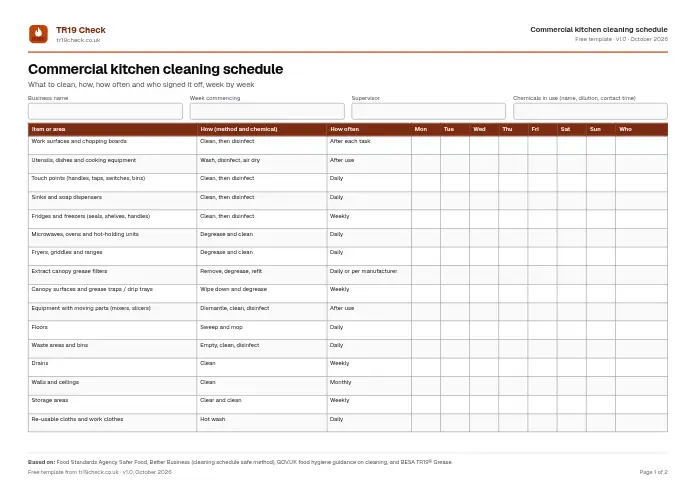
The kitchen is spotless at the end of a good shift. But when a food safety officer asks how you know the fridge seals, drains and extract filters are cleaned every week, a clean kitchen is not the same as proof. GOV.UK puts it plainly: you must be able to prove that you are cleaning effectively, and not cleaning thoroughly is one of the most common reasons food businesses are prosecuted (GOV.UK). A written schedule your team ticks off each day turns good habits into evidence.
Summary of official guidance. From GOV.UK food hygiene: cleaning, the FSA's Safer Food, Better Business and BESA guidance on extract systems. Example frequencies are a starting point, not a rule.
What your schedule must cover
GOV.UK says to set up a cleaning schedule and record, and that the schedule must cover what needs to be cleaned or disinfected, how often, and which products to use. You must regularly clean (GOV.UK):
- work surfaces and chopping boards
- utensils, dishes and cooking equipment
- dish cloths, sponges and tea towels
- touch points such as door handles, bins, light switches and electronic devices
Always clean and disinfect food areas and equipment after they have been in contact with raw food. Check disinfectant labels show BS EN 1276 or BS EN 13697.
How to set it up
- Walk through the kitchen. List everything that needs cleaning, from work surfaces and fridges to the extract canopy filters, drains and bins.
- Write down how. For each item, record the method, the chemical and its dilution and contact time, and the equipment used.
- Set how often. Daily, weekly, after each task, or per the manufacturer. The template starts you off with common items you can edit.
- Assign and tick. Name who does each task and tick each day as it is done. A supervisor checks and signs the week off.
- Add the periodic jobs. Deep cleans, the ice machine, and the specialist extract clean at your TR19® interval go on page 2.
- Review it. Check the schedule still matches your kitchen, retrain staff when it changes, and keep completed sheets.
The FSA's safe method suggests you do not need to disinfect everything: concentrate on items that touch food and frequently touched items such as door and appliance handles. Some specialist equipment has its own instructions for dismantling and cleaning, which you should follow. Train staff on the schedule and supervise the cleaning (FSA SFBB).
Do not forget the extract
Grease does not stop at the filters. BESA says hood filters should be cleaned and degreased daily or according to the manufacturer's instructions, but that no filter is 100 per cent effective: grease passes through and builds up in the ductwork and fan, which is why TR19® requires the entire extraction route to be professionally cleaned (BESA). The template includes filters and canopy surfaces in the daily and weekly list, and the specialist clean on the periodic page.
| Kitchen use | Hours per day | BESA minimum specialist clean |
|---|
| Heavy | 12 to 16 | Every 3 months |
| Moderate | 6 to 12 | Every 6 months |
| Light | 2 to 6 | Every 12 months |
Not sure of your interval? Use the TR19 checker, or plan the dates and get reminders with the TR19 cleaning schedule planner. After each specialist clean, check the report with our TR19 certificate checklist.
Questions
Is a cleaning schedule a legal requirement?
GOV.UK says you must be able to prove you are cleaning effectively, and to set up a cleaning schedule and record. The schedule must cover what needs to be cleaned or disinfected, how often, and which products to use (GOV.UK).
What should a kitchen cleaning schedule include?
The FSA's Safer Food, Better Business safe method says to list everything that needs cleaning and, for each item, how you clean it, what chemicals you use and how, what equipment you use and how often (FSA SFBB).
Which disinfectant should I use?
GOV.UK says to check disinfectant labels include either BS EN 1276 or BS EN 13697, as not all products kill bacteria and viruses (GOV.UK).
How often should extract filters be cleaned?
BESA says extract hood filters should be cleaned and degreased daily or according to the manufacturer's instructions, but that filter cleaning alone does not prevent duct fires: the whole system needs specialist cleaning (BESA).
Can I use my SFBB diary instead?
Yes. The FSA says you can use the cleaning schedule in the SFBB diary, or your own schedule, as long as it covers the right things. This template is an alternative if you want a weekly sign-off sheet.
How long should I keep completed schedules?
There is no single period set out in the GOV.UK cleaning guidance. The FSA says to store completed SFBB diary pages safely until your next visit from a food safety officer, who may want to see them.
Get a TR19 extract cleaning quote TR19 certificate checklist